The Dzogchen Lineage I Follow
From the Buddha to the teacher who gave me my name.
By Orgyen Yenten Dorje
I follow one lineage. I did not choose it; it chose me. I am writing it down so I can see it as a whole, and so a reader who finds this page can see the shape of the stream before stepping in.
The Buddha
The lineage starts, as every Buddhist lineage does, with Shakyamuni Buddha. He taught for forty-seven years in the Ganges plain. From his teaching come the sutras, the vinaya, and — in the Vajrayana traditions — the tantras.
The Great Perfection, Dzogchen, descends through the primordial Buddha Samantabhadra and through a lineage of awareness-holders — vidyādharas — until it reaches the human world through Garab Dorje.
The three Indian masters
Garab Dorje gave the whole path in three lines, which the tradition remembers as the Three Statements That Strike the Vital Point. He passed the transmission to Manjushrimitra, who organised it into three cycles — Mind, Space, and Pith Instruction. Manjushrimitra passed it to Shri Siṅgha, in whose name the Nyingma monastic colleges are still founded.
The arrival in Tibet
In the eighth century, two of Shri Siṅgha’s students carried the Dzogchen teachings across the Himalayas into Tibet. The first was Padmasambhava — Guru Rinpoche. The second was Vimalamitra. This is the founding event of the Nyingma school.
Padmasambhava established the teachings in a form Tibet could receive, and concealed a large number of them as terma — hidden treasures — to be revealed by future tertöns when the time was right. Vimalamitra transmitted the Vima Nyingtik, one of the two streams of instruction Longchenpa would later gather.
Six quiet centuries
Between the eighth century and the fourteenth, the Dzogchen teachings were held by individual masters, by small monastic centres, and by the tertöns who revealed what Padmasambhava had hidden. The transmission did not break. It was waiting for the synthesis.
Longchenpa
Longchen Rabjam Drime Özer — Longchenpa — lived from 1308 to 1364. In his lifetime he composed the Seven Treasuries and the Four Heart Essences. These works gave Dzogchen the form in which it has been studied ever since. Every master since has quoted him. Every curriculum rests on him.
His Precious Treasury of the Way of Abiding is one of the great books of the human mind. It is also difficult, and it rewards slow reading over years.
Jigme Lingpa and the Longchen Nyingtik
Four centuries after Longchenpa, in 1757, Jigme Lingpa was in his second retreat at Chimphu when Longchenpa appeared to him in three successive visions and transmitted the cycle that became known as the Longchen Nyingtik — the Heart-Essence of Longchenpa. The cycle contains the outer and inner preliminaries, the main practice, and the intermediate instructions a student needs to walk the whole path.
Patrul Rinpoche’s Words of My Perfect Teacher, composed in the nineteenth century, is the classical manual of this cycle and is still the first book every serious student is asked to read.
Dzogchen Monastery
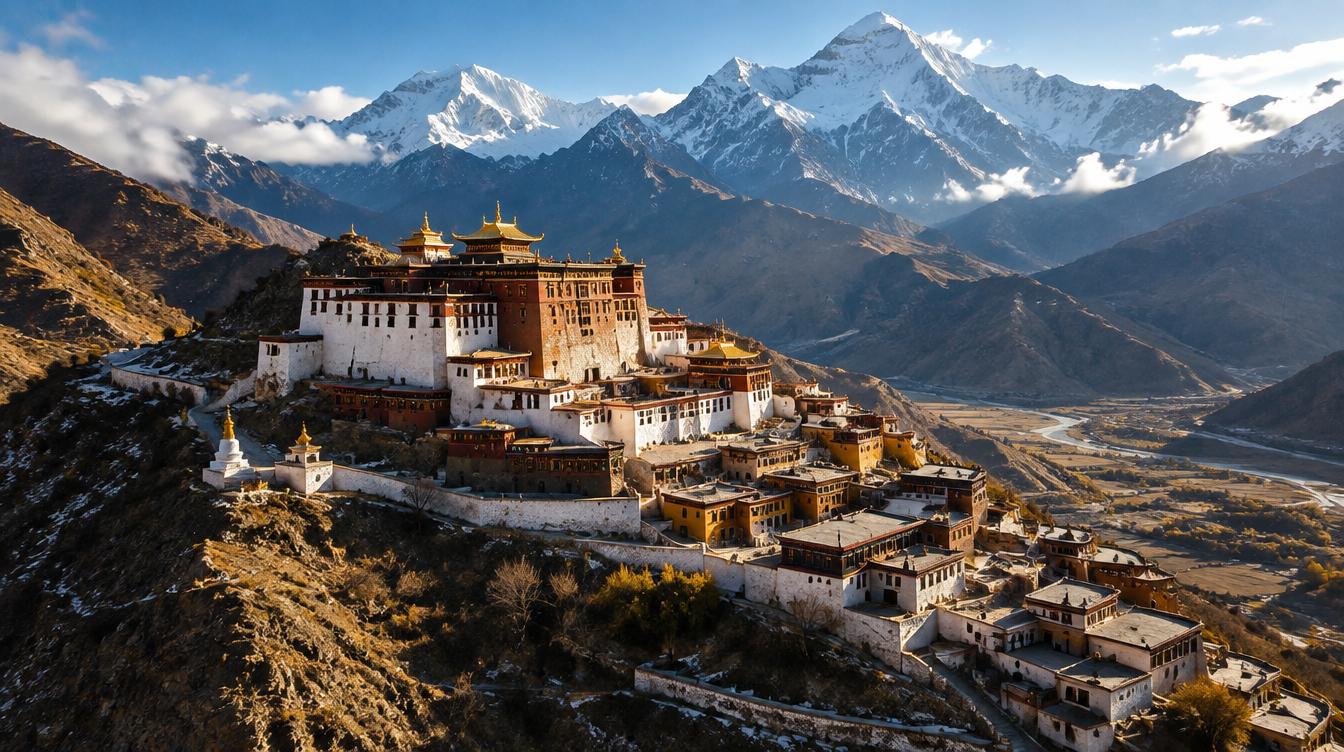
The physical seat of the lineage is Dzogchen Monastery, founded in 1684 in the Rudam region of Kham by the first Dzogchen Rinpoche, Pema Rigdzin. In 1842 an earthquake destroyed much of the complex. Gyalse Shenphen Thaye rebuilt it, and founded the Shri Siṅgha college as part of the rebuilding.
The nineteenth century at Dzogchen Monastery produced some of the Nyingma school’s greatest masters — Patrul Rinpoche, Mipham Rinpoche, Khenpo Shenga — whose work is still studied in every shedra.
I have been to the valley. Solo, some years back, on a longer trip through Tibet. Reading Patrul Rinpoche on the ground he wrote from is not the same as reading him on a boat in the Mediterranean, and the difference is worth having felt once.
The twentieth century
The twentieth century broke much of what had been built. The monastery itself was almost lost. Many monks did not survive. Libraries were destroyed. The lineage did not disappear only because a small number of masters — some very old, some very young — carried what they could carry across the Himalayas and continued the transmission wherever they settled. Others stayed, at great cost, and later contributed to the partial rebuilding of the monastery.
Nyoshul Khenpo’s Marvelous Garland of Rare Gems is the record from the inside, including the twentieth-century holders. Read it after Patrul Rinpoche.
Where the lineage stands now
The Longchen Nyingtik cycle is being transmitted today — at Dzogchen Monastery in its reconstructed form, and by those who hold it in the current generation. They teach in Asia, in Europe, in the Americas. All of them work from the same body of practice Jigme Lingpa received in 1757 and Patrul Rinpoche described in the nineteenth century.
Lineage does not mean nostalgia. It means the transmission has not been broken.
The reader drawn to this stream will eventually need to find a teacher and begin the practice. Everything on this site is preparation for that.
— Оргьен Йентен Дордже
Sources
- Patrul Rinpoche, The Words of My Perfect Teacher, tr. Padmakara Translation Group, HarperCollins 1994 / Shambhala 1998 / Yale 2010.
- Nyoshul Khenpo, A Marvelous Garland of Rare Gems: Masters of Awareness in the Dzogchen Lineage, tr. Richard Barron, Padma Publishing 2005.
- Longchenpa, The Precious Treasury of the Way of Abiding, tr. Richard Barron, Padma Publishing 1998.