Reading Buddha's Words on Watch
Notes from a working captain who took refuge fifteen years ago.
By Orgyen Yenten Dorje
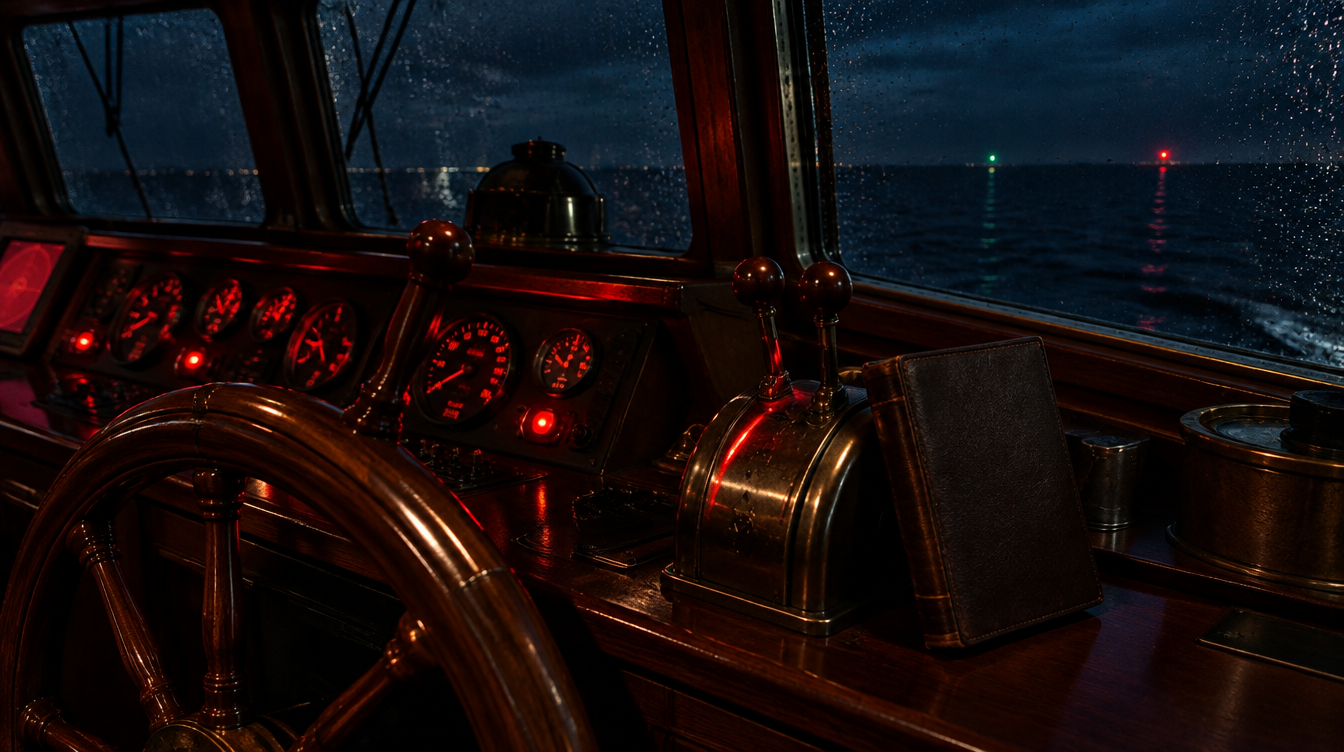
The book was on the console. I had the midnight-to-four off the north coast of Sicily. Ten knots on the nose, the sea short but nothing that mattered, the mate below, one target on the AIS holding station on a fishing bank. I opened the Dhammapada where I had left it three days earlier and read for the length of a coffee.
It is what I do most nights on watch when the sea is behaving. A few verses. Close the book. Back to the horizon. There is nothing devotional about it. It is the way I have found to keep the practice present in a working life without having to invent time that does not exist.
I began on Baltic sailing boats before I began anything else. Twelve years as captain now, sixteen or so total professional at sea. Full-time on the ship until three years ago. Now on rotation. The change in tempo is a large part of why this site is here — rotation gives a person time to write.
The vessel names are under confidentiality. What I can say is that the range has been from about fifty-three to sixty-seven metres, mostly commercial, now private in the Mediterranean.
The seasons, briefly
I count in seasons more than in years.
Many Caribbean seasons. The Bahamas are my favourite piece of water on the planet — the light, the depth of the shallows, the exact turquoise you do not see anywhere else. Panama Canal transits both ways, more than once, moving boats between the Caribbean and Alaska with weather waits in San Diego. Mexico coast. Turkey, Adriatic, Croatia, Venice. Years based in Genoa. Years based in Fort Lauderdale. Miami is familiar ground. Thailand and Malaysia and Thailand again.
I have made several Atlantic crossings. One of them in 2015, on a sailing boat, with a sextant, Spain to Barbados, prep for the Master Ocean exam. That exam I took in Antigua. On another leg I signed onto Wild Swan and ran a passage from Reykjavik to the Netherlands with a boat full of trainees. On another I flew to Ushuaia and stood watches through the Drake Passage around Cape Horn and back. On another I helped deliver what was then the world’s largest trimaran from Riga through Biscay through Gibraltar to Greece.
I have crossed the Red Sea, taken a boat through the Somali high-risk corridor to Malé, and put a lot of miles into Southeast Asia. I write these plainly because the first draft of this site had me inventing details and the review caught me.
How I got to the Dharma
At twenty-four, in 2010, I joined the Buddhist Leadership Exchange Program in Thailand. It was a Theravada-rooted immersion and it was the first time I stood next to the tradition properly.
From Thailand I went to India — ashrams, yoga, sitting practices — and started travelling to the places the tradition names. Mongolia. Buryatia. Altai. Tibet more than once, including Lhasa and the Dzogchen Valley. Nepal many times. Burma, Cambodia, Borobudur in Java, India again and again. I sat quietly at Lumbini, Bodh Gaya, Kushinagar, Sarnath — the four places where the Buddha was born, awakened, first taught, and passed away.
I met His Eminence Dzogchen Kenpo Choga Rinpoche in September 2011, in Nepal. I took refuge with him in the same week. He gave me the name I sign at the bottom of everything on this site. I have seen him roughly thirty times in the fifteen years since — in retreat, on pilgrimage in Nepal, India, Bhutan and Taiwan, and in the plain sitting-with that a real teacher-student relationship is mostly made of.
I studied across levels. Theravada groundwork first, then the Mahayana sutras and Śāntideva, then the Nyingma preliminaries under Rinpoche. I do not particularly hold that any of the three is more real than the others. Each has done specific work in me. The traditions themselves teach this — they are graded expressions of the same intention.
The mistake
Somewhere around 2016, when I had a captain’s ticket and enough Buddhism in me to be dangerous, I decided I would sit on the boat like a monk. Two hours of formal practice a day. Small shrine in the cabin. Serious face.
It lasted a few weeks. The boat does not have two hours of consecutive quiet for the person in command. It has a night watch during which you cannot close your eyes. It has weather that changes in the small hours and needs a decision. It has communications from the shore team at any hour, because the shore team keeps its own schedule and the boat is where the day lands. On rotation, whatever you build ashore falls apart on day three at sea.
The next time I saw Rinpoche I complained about the impossibility of finding two hours. He said, in a tone I remember, that the ambition was the problem, not the boat. Learn the instructions the tradition has for people whose lives cannot be rearranged. Stop practising against the boat.
That correction is the pivot of my practice. The lay lineage is old. Nyoshul Khenpo’s Marvelous Garland has some yogins in it, alongside the monks. I had imported the wrong template.
What the sea teaches without meaning to
Running a boat is running a boat. It is not a spiritual practice. But the pressures it puts on a person map onto things the tradition names precisely, and once you notice the map you cannot un-notice it.
Impermanence. You do not need a Dharma class on it if you have watched a plan come apart in the first three hours of a passage. The forecast gave you twenty-five knots northeast and it is thirty and it is not easing. The sea steepens on the beam. A system that ran without complaint for four years chooses 03:00 to develop a symptom you have not seen before. Patrul Rinpoche’s four reflections, which sound abstract in a warm room, arrive on their own if you spend a year on a bridge.
Attention. Not the attention of a cushion, trained by turning away from noise. The attention of the wheelhouse, which is trained inside the noise because there is nowhere to turn. Four hours of watch. Nothing dramatic, most of the time. A horizon. An RPM number. The AIS. The small variation in the way the hull sits under you. The mate calls you for a change in visibility, or a target that is not behaving as expected, or a shift in the noise from below that he cannot yet name. You go up. Over years, this does something to the substrate.
Command. The tradition is unusually accurate about what a captain is doing at 02:30 when the decision is his and there is no one to pass it to. You can consult. You cannot delegate the responsibility. The bridge is full and quiet. Everyone is waiting on you for the answer. The safest call is often the least popular. Once you have made it, the harder part begins, which is making it workable — for the plan that had been laid, for the day that had been anticipated, for the schedule the shore team is holding — and this is what command mostly consists of, the translation of a technical limit into language a reasonable person will accept, and the carrying, alone, of the fact that the decision was yours and the consequence would also have been yours.
Aftermath. Wind alarm at 03:00. Anchor snubber taking a load in a shift you did not want. Engineer at the door because number three exhaust temperature is high and rising. Every experienced captain has run these sequences more times than he can count. Somewhere along the way the irritation goes out of them. Not because you have suppressed it — because you have stopped believing the story that the systems are supposed to work all the time. Machines are supposed to fail sometimes and be brought back. Once that expectation is real, the failure is the next task.
The parallel biographies
Two lives.
The sea one. Baltic in the beginning. Sailing boats young. Deck work, then mate, then chief officer. Ticket in 2014. Twelve years in command. Boats fifty-three metres, sixty-five, sixty-seven. Miles enough. Weather enough. The Master Ocean in Antigua after the sextant crossing. The Drake Passage. The Somali corridor. The trimaran out of Riga. Two continents of familiar ports. Now on rotation.
The reading one. BLEP at twenty-four. India the year after. Refuge with Rinpoche in September 2011 in the same week I first met him. Dhammapada as the first sustained companion. Words of My Perfect Teacher a few years later, slowly. Way of the Bodhisattva not long after that. Longchenpa in Barron’s translations — I have read parts, I have not finished parts, and it is a life-long project rather than a bookshelf claim. Nyoshul Khenpo’s Marvelous Garland for the human texture of the line. Ngöndro under Rinpoche: outer accumulations complete, inner accumulations underway, and I aim to finish the inner in the next two years.
Cross-tradition. Not eclectic. With ground in what Rinpoche gave and open to what the earlier vehicles teach.
Now
The morning sit is ten to forty minutes, depending on the day. On mornings that allow more, I do more. On mornings that do not, I do ten and I do not apologise for the ten.
I read a paragraph of a primary text with the first coffee. Do the specific preliminaries Rinpoche has asked for, at the counts he asked. Try to work with what shows up in the day — the specific work, the message from the shore team, the weather that has changed since dinner — without immediately turning it into a story about myself. I fail at this often. In the evening I read another half-hour if the day allows, longer if it does not, and I dedicate whatever the day produced to whoever it might benefit.
I am also, in parallel, doing a master’s at the University of South Wales. That will be its own biography one day.
Why the site
I am not building a platform. I am not selling anything. I am not saying anyone should be here.
I am writing down what I have learned so far, at a specific speed, from a specific working life and a specific transmission, on the chance that a phrase is useful to another practitioner somewhere. If you are working at sea and looking for a version of the Dharma that fits the way your life actually runs, you may find one paragraph here worth the reading. If you are curious for other reasons, welcome.
The reference points I trust are on the reading list. If a book is worth mentioning, I have mentioned it there. The classical texts are older than any current teacher — begin with those.
Everything I know about the practice I have from Rinpoche. Everything I know about the sea I have from the men and women who taught me on boats. Neither debt is the sort you can repay. You pass it forward slowly. This site is a small piece of that.
The Dhammapada is still on the console tonight. The mate has an hour left. The horizon is where it should be. The fishing target has cleared. It is going to be a quiet passage.
— Оргьен Йентен Дордже
Sources
- The Dhammapada, tr. Gil Fronsdal, Shambhala 2005; Russian tr. V. N. Toporov, various editions.
- Patrul Rinpoche, The Words of My Perfect Teacher, tr. Padmakara Translation Group, HarperCollins 1994 / Shambhala 1998.
- Śāntideva, The Way of the Bodhisattva, tr. Padmakara, Shambhala 1997.
- Nyoshul Khenpo, A Marvelous Garland of Rare Gems, tr. Richard Barron, Padma Publishing 2005.