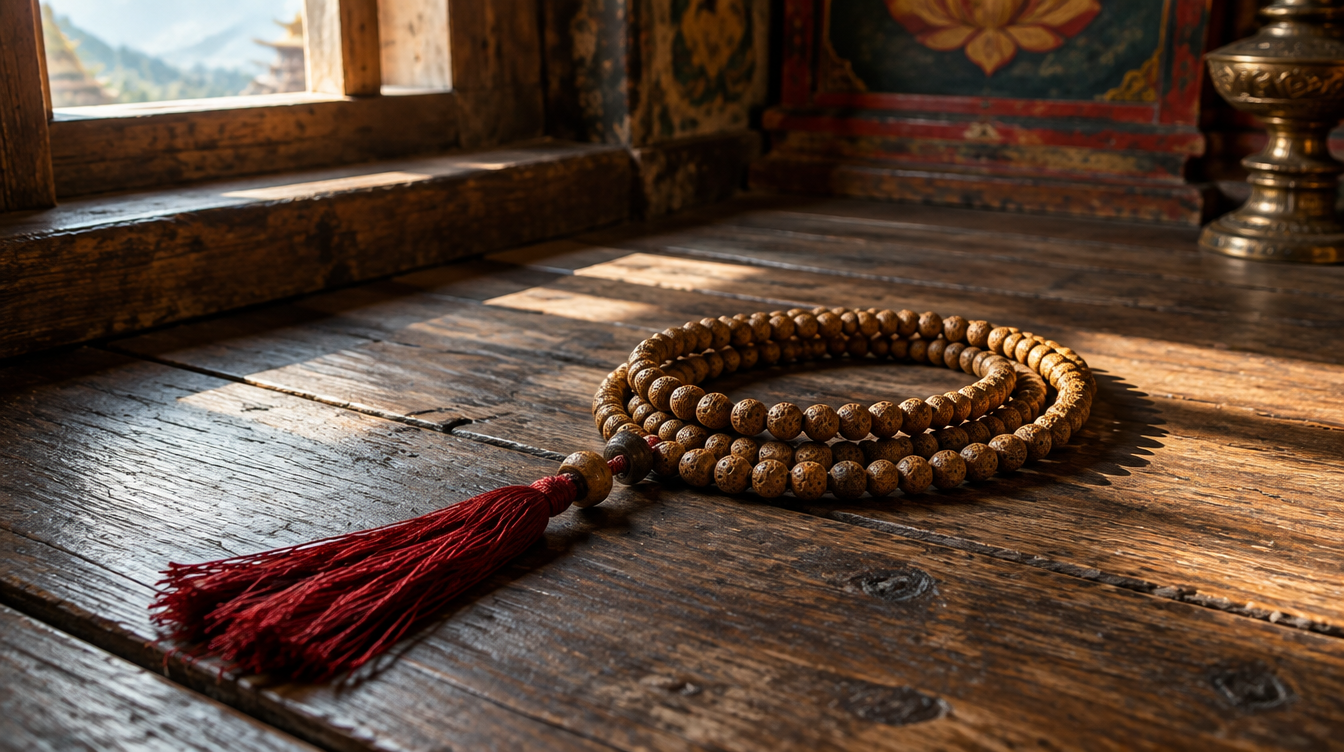
What Ngöndro Is
The preliminary practice of the Nyingma path — informational, not instruction.
By Orgyen Yenten Dorje
The word ngöndro (Tibetan སྔོན་འགྲོ, literally what goes before) is usually translated preliminary practices. The translation is accurate but it produces a wrong idea. It makes the practice sound like a warm-up. It is not a warm-up. In the Nyingma tradition, Ngöndro is the training that makes every subsequent practice possible.
This is an informational description of what Ngöndro is in the lineage I work in. It is not instruction. Whether or not to take up Ngöndro, and how to take it up, is a matter for a qualified teacher and cannot be given from a book or a website.
The shape of it
Ngöndro has two layers.
The outer preliminaries are contemplative. A set of reflections on the ground of Buddhist practice, meant to turn the mind toward the path in the first place. They are not techniques to master; they are perspectives to internalise.
The inner preliminaries are formal accumulations — specific practices, with specific liturgies, visualisations and mantras, repeated to specific counts under the teacher’s supervision. They perform specific functions in the training of the practitioner’s mind, body and speech, and prepare the ground for the main practice.
Both layers together are what the word Ngöndro names.
Six accumulations, as taught in this lineage
The reflections that ground the outer preliminaries in the way my teacher gives them are these six.
- My human life is precious.
- My life is impermanent.
- Grasping at a self is what saṃsāra is.
- The law of cause and effect is infallible.
- Nirvāṇa is a mind without self-grasping.
- The Vajra Master is the embodiment of the Buddha.
Each one is meant to be sat with, not memorised. Sitting with the second — impermanence — for a week can change a day differently than sitting with it for an afternoon. Sitting with the third — that grasping at a self is saṃsāra — for a month begins to shift something about how the day is experienced. These are not slogans. They are perspectives that alter the substrate.
They are also, taken together, the corrective to a set of assumptions the mind carries by default: that this life will be indefinitely long, that its usual pleasures will be indefinitely satisfying, that there is a self at the centre of the arrangement, and that the ordinary running of things carries its own solution. Without these reflections, the main practice has no ground to land in.
The inner accumulations
Refuge and prostrations. Bodhicitta. Purification. Offering. The specific transmissions the Longchen Nyingtik cycle contains — each carried out with its own liturgy and its own count.
I do not intend to describe the interior of them in a public essay. They are transmitted person to person, they require specific empowerments before they can be undertaken, and writing about them in a general way misrepresents what they are.
What I can say, since it is my own state and not somebody else’s practice: outer accumulations complete, inner underway, aim to finish the inner within the next two years. That is a slower pace than a monastic timeline. It is the pace a lay life on rotation permits.
Why the tradition places it first
Ngöndro is what goes before, in the sense that a foundation goes before a building.
Any teacher of any Nyingma lineage will tell you the same thing. The higher teachings cannot be received without this ground. Not because a teacher is withholding them. Because a mind that has not been through Ngöndro cannot hold what the higher teachings are pointing at. It will glance off.
The count in the inner accumulations is not superstition and it is not a spiritual scoreboard. It is what is required for the practice to move from a technique the mind is performing to a state the mind has become. Anyone who has done a serious count of any of the classical accumulations recognises this. The first ten thousand feel like the mind you brought to them. Somewhere later, the mind is different. Somewhere later still, the mind is no longer the subject of the practice at all.
Where the tradition puts responsibility
Under a qualified teacher. Not a book. Not a video. Visualisations need correction. Postures need correction. Motivation needs correction. It is a practice that repays enormous care in its setup and punishes shortcuts that seem, at the beginning, invisible.
If you are within a Nyingma lineage, the specific liturgy will be given to you by your teacher. If your practice is in another school, the specific text will differ; the structure and the seriousness will not.
Ngöndro is what goes before, in the sense that everything else rests on it.
— Оргьен Йентен Дордже
Sources
- Patrul Rinpoche, The Words of My Perfect Teacher (Kunzang Lama'i Zhal-lung), tr. Padmakara Translation Group, HarperCollins 1994 / Shambhala 1998 / Yale 2010 — the classical manual for the Longchen Nyingtik preliminaries.
- Jigme Lingpa, Longchen Nyingtik root cycle — the eighteenth-century revelation from which the practice descends.
- Nyoshul Khenpo, A Marvelous Garland of Rare Gems, tr. Richard Barron, Padma Publishing 2005.