Wisdom of Buddha
Notes from a sea captain who took Buddhist refuge.
By Orgyen Yenten Dorje
The clouds come first. From the bridge wing at the start of the midnight-to-four, before the barometer has confirmed anything and before the mate has named it from the saloon radio, the sky is already signalling — altocumulus laid thin as fish-scales across the west, the mares’ tails on the upper layer running slantwise to the surface wind, and far down the horizon a bar of lower cloud going from grey to grey-blue by stages so slow a man would miss them if he were not already looking. On watch at sea one learns to read clouds the way a priest reads a face: not for what they say, but for what they are about to admit. They are weather and they are mood at the same time, and the long habit of reading them for both at once, without confusing one register for the other, is the first discipline the sea gives to a working life, and perhaps also the last.
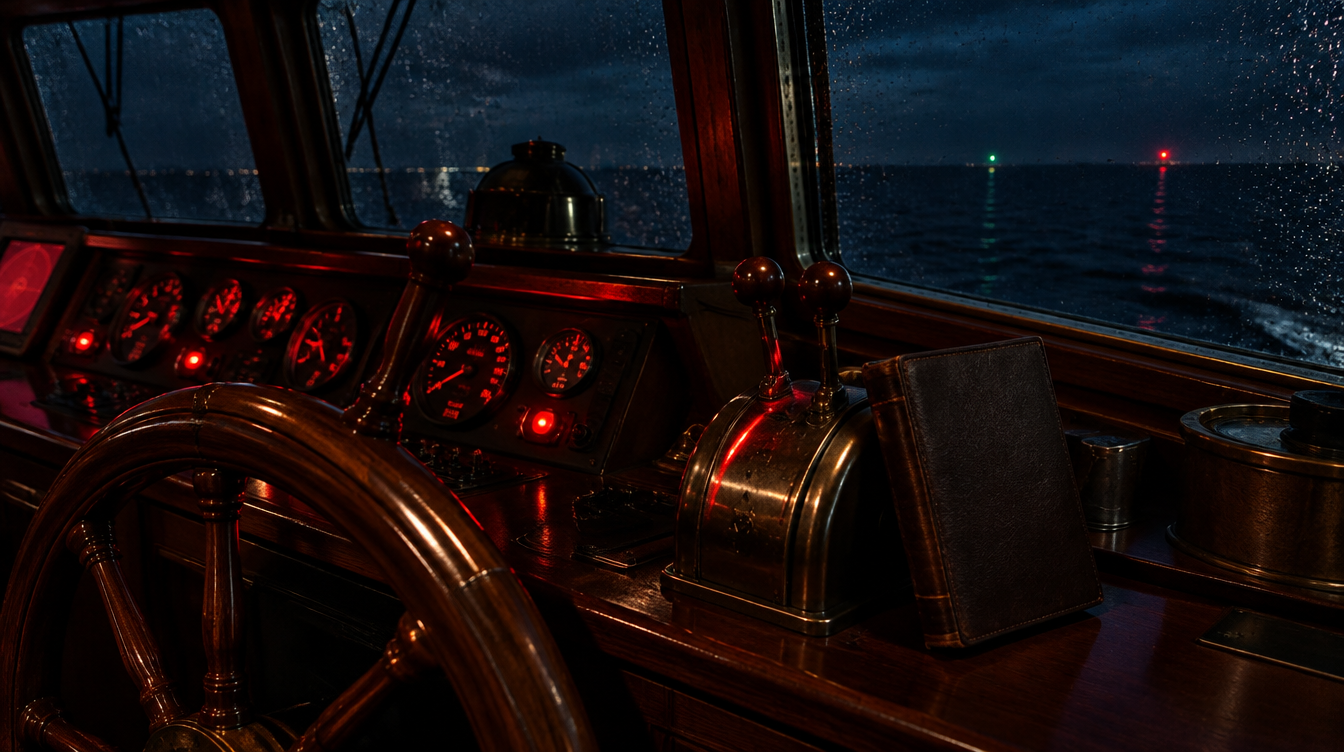
The book was on the console. We had the midnight-to-four off the north coast of Sicily. Ten knots on the nose, the sea short but nothing that mattered, the mate below for his two hours, one target on the AIS holding station over a fishing bank. I opened the Dhammapada where I had left it three nights before and I read for the length of a coffee, lifting my eyes to the horizon between stanzas as a man lifts them from any work he loves, which is to say frequently and without impatience.
It is what I do on nights when the sea is behaving. A few verses. Close the book. Back to the horizon. Nothing devotional about it. It is the way I have found, over the years, to keep the practice present inside a working life, without having to invent time that does not exist.
I came to the sea on Baltic sailing boats as a boy, long before anyone paid me for it. Years of amateur sailing before the first paper — the Skipper certificate came in 2014. From there deck work, then officer of the watch, then Chief Mate — diploma in 2021 — and Captain, diploma in 2023, three years ago now. Over a decade professional at sea in all. The yacht’s name is under confidentiality. Her size is not: fifty-two metres, in the Mediterranean, private. Earlier vessels: fifty-three, sixty-five, sixty-seven metres, mostly commercial. On rotation only since the captaincy — before that, permanently aboard.
A yacht speaks of itself as a crew. We arrived in Palma on the ninth. We held station outside Villefranche through the mistral. We lost a generator between Cephalonia and Zakynthos and we got her running again by first light. On a boat it is almost always we — the hands that worked the lines, the officer who called the move, the engineer who found the fault, the chef who kept the galley open when the sea was high. Which is useful, because the Dharma says the I is not what we think it is, and the yacht has been correcting the grammar for a hundred years without ever reading a sūtra.
Seasons, not years
Those who count their life ashore count it in years — the fiscal year, the calendar year, the review cycle, work anniversaries, the long slow annual rhythm of holiday and tax — because a year ashore divides cleanly into twelve months and three of them are enough to notice the thing has passed. We count seasons at sea, not years, because a season is not a brochure label but the actual migration a yacht makes across the planet: Mediterranean in summer, Caribbean in winter, the delivery passages between them — and the markers of a working life in this trade are the passages themselves and the weather of each, not a calendar someone built for an accountant and a tour operator.
Many Caribbean seasons. The Bahamas are the loveliest water I know anywhere — the depth of the shallows, the exact turquoise that is not duplicated in any other sea. Panama Canal transits in both directions, more than once, moving boats between the Caribbean and Alaska with weather waits in San Diego. The Mexican coast. Turkey, the Adriatic, Croatia, Venice. Seasons in Genoa. Seasons in Fort Lauderdale. Miami familiar. Thailand and Malaysia and Thailand again.
Passages
We crossed the Atlantic several times. One of them in 2015, on a sailing boat, Spain to Barbados, with a sextant, in preparation for the Yachtmaster Ocean exam. I took the exam on Antigua after the crossing. On another passage I joined the crew of the schooner Wild Swan as watch officer, and we ran her from Reykjavik to the Netherlands with a boat full of trainees. On another I flew to Ushuaia and stood watches with the crew through the Drake Passage, around Cape Horn and back. On another I was aboard the delivery of what was then the world’s largest sailing trimaran, from Riga through Biscay through Gibraltar to Greece.
We crossed the Red Sea; we took a boat through the Somali high-risk corridor down to Malé; and we put a great many miles into Southeast Asia.
How I came to the Dharma
Kalmykia first. Long before I ever used the word lineage, I went to the Russian steppe to see what Tibetan Buddhism looked like in a place where it had lived for centuries without a tourist economy to shape it. That was the first encounter. Nothing happened that would make a story — a monastery, some prostrations, a quiet afternoon in a prayer hall — but the texture of the thing stayed with me, and it was the texture, not an idea, that sent me looking for the rest.
In 2010, at twenty-four, I went with my sister on the Buddhist Leadership eXchange — BLX — through Thailand and India. A Theravāda-rooted immersion, long days, quiet nights, the first time I stood next to a tradition properly instead of reading it on paper. From there I went back to India many times, alone: ashrams, yoga, sitting practices, and slow travel to the places the tradition names. Mongolia. Buryatia. Altai. Tibet more than once, including Lhasa and the Dzogchen Valley. Nepal many times. Burma, Cambodia, Borobudur in Java. I sat quietly at Lumbini, Bodh Gaya, Kushinagar, Sarnath — the four places where the Buddha was born, awakened, first taught, and passed away.
I met my teacher, His Eminence Dzogchen Kenpo Choga Rinpoche, in September 2011, in Nepal. I took refuge with him that same week. He gave me the name I sign at the bottom of this page. I have seen him some thirty times in the fifteen years since — in retreat, on pilgrimage in Nepal, India, Bhutan and Taiwan, and in the plain sitting-with that a real teacher-student relationship is mostly made of.
I studied across levels. Theravāda groundwork first, then the Mahāyāna sūtras and Śāntideva, then the Nyingma preliminaries under Rinpoche. I do not hold that any of the three is more real than the others. Each has done its specific work in me. The traditions themselves teach this — they are graded expressions of a single intention.
The mistake
Somewhere around 2016 I had enough miles in me to be useful on a boat and enough Buddhism in me to be dangerous. I had just stepped into my first chief rank — officer of the watch, moving toward Chief Mate, the diploma itself still five years off, the Captain’s farther still. I decided I would sit on the boat like a monk. Two hours of formal practice a day, a small shrine in the cabin, a serious face. It lasted a few weeks.
Then I decided I had been thinking too small. What I wanted was not two hours in a cabin — it was a cave. A real one, the kind the old yogins went into. Not two hours but a year, maybe three. I would withdraw into mountain and silence, far from the noise of a working life, and from the inside of that silence the practice would mature as the texts describe.
That year I made pilgrimage with Rinpoche. Lumbini in Nepal, where the Buddha was born. Sarnath in India, where he first taught. On a quiet afternoon between the two I told my teacher the plan, with the slight embarrassment of a man describing his escape to someone who sees through it. He said, in a tone I remember, that the ambition was the problem, not the boat and not the city. Stay in the world. Practise among people. A yacht and a city are the two places where the whole range of human life is visible without screens — anger, fear, pride, generosity, grief, boredom, kindness, exhaustion, every one of them at close range, every day, with nowhere for anyone aboard to hide any of it from anyone else. A cave hides most of it from the practitioner. The yacht hides nothing. There is no better classroom for someone who means to work with the mind as it actually is.
That correction is the pivot of my practice. The lay lineage is old. Nyoshul Khenpo’s Marvelous Garland has yogins in it alongside the monastics. I had imported the wrong template, and Rinpoche returned me to the right one.
What the sea teaches without meaning to
Running a boat is running a boat. It is not a spiritual practice. But the pressures the work puts on a person map onto what the tradition names with precision, and once we notice the map we cannot un-notice it.
Impermanence. The forecast gives fifteen knots east for the first day of a passage, flat sea, blue sky, a long easy roll from a system two days spent. By mid-morning the mares’ tails lie slantwise across the sky, not where the forecast said they would, and the barometer, patient the whole night, begins its first slow decline. Three millibars in three hours is nothing dramatic in a textbook; on the bridge it is the beginning of a different afternoon. Grey wrack thickens up the western quarter. The squall line, when it comes, comes in a formation the chart did not promise, and the autopilot, which has held her steady for weeks, begins to hunt a degree each way, then two, then three, until the mate goes to hand steering and we ride her through on muscle. Patrul Rinpoche’s four thoughts that turn the mind, which sound abstract in a warm room, arrive on their own if a man spends a year on a bridge.
Attention. Not the attention trained on a cushion by turning away from noise — the attention of the wheelhouse, trained inside the noise, because there is nowhere to turn. Four hours of watch, with the window the whole four hours. Wind speed. Wind direction. Sea state and the way it folds the old swell from a system two days east into the new wind-wave. Set and drift. Traffic — ships on parallel courses, fishing vessels on erratic ones, a sailing yacht far off refusing to show herself cleanly on the AIS. Radio traffic in two languages. The barometer every half hour, with its trend. Fuel. Port generator temperature. Starboard generator temperature. Main-engine exhaust temperature. Bilge. Deck lights. The quiet sum of the vessel’s own noises, which the ear learns to recognise the way a mother recognises her child’s voice in a schoolyard — any shift and the ear knows before the eye. Sunset. Moonrise. Where each member of the crew is at this exact moment. The alarms that will come, that always come: wind alarm, course-deviation alarm, high generator temperature, low fuel level, radar alarm, bilge alarm, the knock at the door at an hour one had hoped nobody would knock. And through all of it, a line held somewhere in the chest for the ten-second decision — because the mate can call at any moment and the ten seconds one has to answer may stand between the vessel and the reef, between the crew and the water, between a hull worth several million euros and an insurance file that will follow a man for years. The weight does not go away. Over years, it does something to the substrate.
Command. The tradition is unusually accurate about what a captain is doing at 02:30 when the decision is his and there is no one to pass it to. One can consult. One cannot delegate the responsibility. The bridge is full and quiet. Everyone is waiting on him for the answer. The safest call is often the least popular. Once he has made it, the harder part begins, which is making it workable — for the plan that had been laid, for the day that had been anticipated, for the schedule the shore team is holding — and this is what command mostly consists of, the translation of a technical limit into language a reasonable person will accept, and the carrying, alone, of the fact that the decision was his and the consequence would also have been his.
Consequence. Wind alarm at 03:00. Anchor snubber taking a load in a shift one did not want. Engineer at the door because the starboard generator temperature is climbing. Five minutes later it is still climbing. The main-engine exhaust reads five degrees past its line and will read more if the fault is upstream of the cooler. Every experienced officer has run these sequences more times than he can count. Somewhere along the way the irritation goes out of them. Not because he has suppressed it — because he has stopped believing the story that systems are supposed to work all the time. Machines are supposed to fail sometimes and be brought back. Once that expectation is real, the failure is simply the next task.
The two biographies
Two lives, running on the same clock.
The sea one. Baltic boys’ sailing in the beginning. The Skipper certificate in 2014. Deck, officer of the watch, Chief Mate — diploma 2021. Captain diploma 2023. Three years in command now; over a decade at sea professionally, with the amateur Baltic years before that, which count too, because that is where the hands first learned. Vessels fifty-three, sixty-five, sixty-seven metres. Current yacht fifty-two. Miles enough. Weather enough. Yachtmaster Ocean on Antigua after the sextant crossing. The Drake. The Somali corridor. The trimaran out of Riga. Two continents of familiar ports. On rotation only since the captaincy.
Dharma practitioner. Kalmykia first, before I had the vocabulary. BLX with my sister in 2010, Thailand and India, at twenty-four. India many times after, alone. Refuge with Rinpoche in Nepal in September 2011, the same week I first met him. The Dhammapada as the first sustained companion. The Words of My Perfect Teacher a few years later, slowly. The Way of the Bodhisattva soon after that. Nyoshul Khenpo’s Marvelous Garland for the human texture of the line. Ngöndro under Rinpoche: outer accumulations complete, inner accumulations underway, with the aim of finishing the inner in the next two years.
Cross-tradition, not eclectic. Ground in what Rinpoche gave; openness to what the earlier vehicles teach.
Now
Morning meditation is ten to forty minutes, depending on the day. On mornings that allow more I do more. On mornings that do not, I do ten, and I do not apologise for the ten.
An old alpinism trainer of mine used to say it was better to climb a wall once forty times than never to climb a wall forty times. I kept the sentence. In the practice it means the same thing — better one real minute than a planned forty that never happens. If a man can do one minute, he can do a second. He can find a third. He can try a fourth. The ambition will build its own house once there is a floor to build it on; without the floor it is only architecture.
A paragraph of a primary text with the first coffee. The specific preliminaries Rinpoche gave, at the counts he set. Work with whatever the day brings — the specific job, the message from the shore team, the weather that has shifted since dinner — without turning it immediately into a story about oneself. I fail at that often. In the evening another half-hour if the day allows, longer if it does not, and I dedicate whatever the day has produced to whoever it may benefit.
In parallel I am reading for a master’s at the University of South Wales. That will have its own biography one day.
Why this site
I am not building a platform. I am not selling anything. I am not telling anyone they should be here.
I am writing down what I have learned so far, at a specific speed, from a specific working life and a specific transmission, on the chance that a phrase might be useful to another practitioner somewhere. If you work at sea and you are looking for a version of the Dharma that fits the way your life actually runs, perhaps one paragraph here will be worth the reading. If you are curious for other reasons, welcome.
Look for a Dharma you would actually want to practise — one that would help the way your days run, even a little. Better still, one that leads you, one minute at a time, toward the state of a Buddha. That is enough. There is no larger instruction.
The reference points I trust are on the reading page. If a book is worth mentioning, I have mentioned it there. The classical texts are older than any teacher now living — begin with those.
Everything I know about the practice I have from Rinpoche. Everything I know about the sea I have from the men and women who taught me on the boats. Neither debt is the kind that can be repaid. One passes it forward, slowly. This site is a small piece of that.
Coda
The Dhammapada is still on the console. The mate has an hour left of his two. The horizon is where the horizon should be. The fishing target has cleared east.
Westward the sky has already begun its slow rearrangement. The altocumulus of three hours ago has thinned and is being replaced by the long cold rollers of cirrus — ice crystals the sun will meet first in the morning, two hours before it reaches our deck. The colour of the lower bank is no longer grey; it is a shade of blue that has not yet decided whether it belongs to the night that is leaving or the day that is coming. Nothing in the sky is where it was at the start of the watch. The whole canopy depends on everything else — on the pressure to the north and the temperature of the water beneath us and the long high river of air that pours continuously eastward over this piece of sea whether anyone is watching it or not — and the whole canopy will be different again by sunrise, and different again by noon, and different for the whole of the time this vessel and this crew are afloat under it. There is nothing a man can hold. There is nothing he needs to hold.
I turn back to the console. A verse, then another. Close the book. Back to the horizon. The watch is where the watch is.
— Оргьен Йентен Дордже
Sources
- The Dhammapada, tr. Gil Fronsdal, Shambhala 2005; Russian tr. V. N. Toporov, various editions.
- Patrul Rinpoche, The Words of My Perfect Teacher, tr. Padmakara Translation Group, HarperCollins 1994 / Shambhala 1998.
- Śāntideva, The Way of the Bodhisattva, tr. Padmakara, Shambhala 1997.
- Nyoshul Khenpo, A Marvelous Garland of Rare Gems, tr. Richard Barron, Padma Publishing 2005.